Project
WARDEN - SDA Threat Response
A high-fidelity operational concept for Space Domain Awareness threat escalation.
Details
About
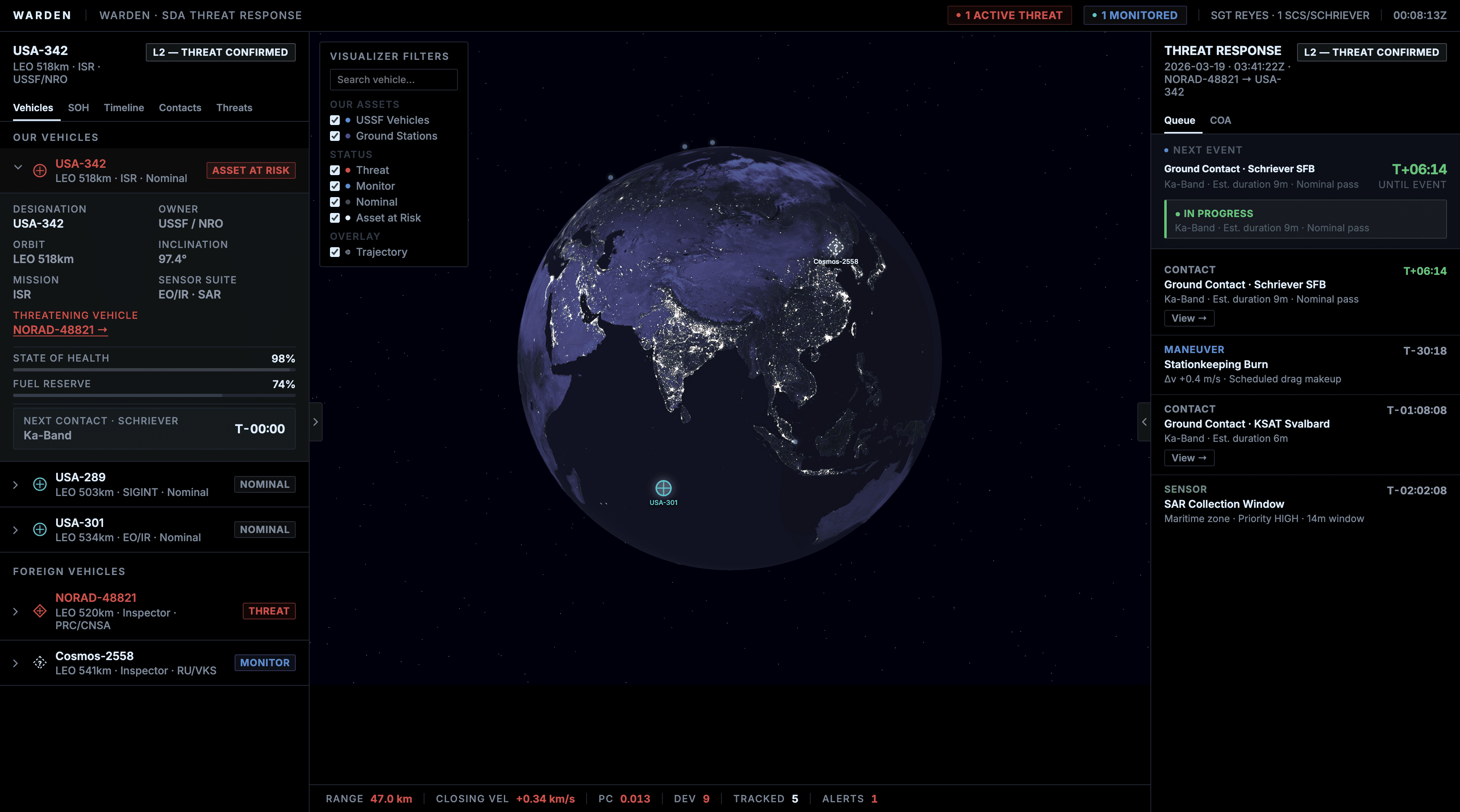
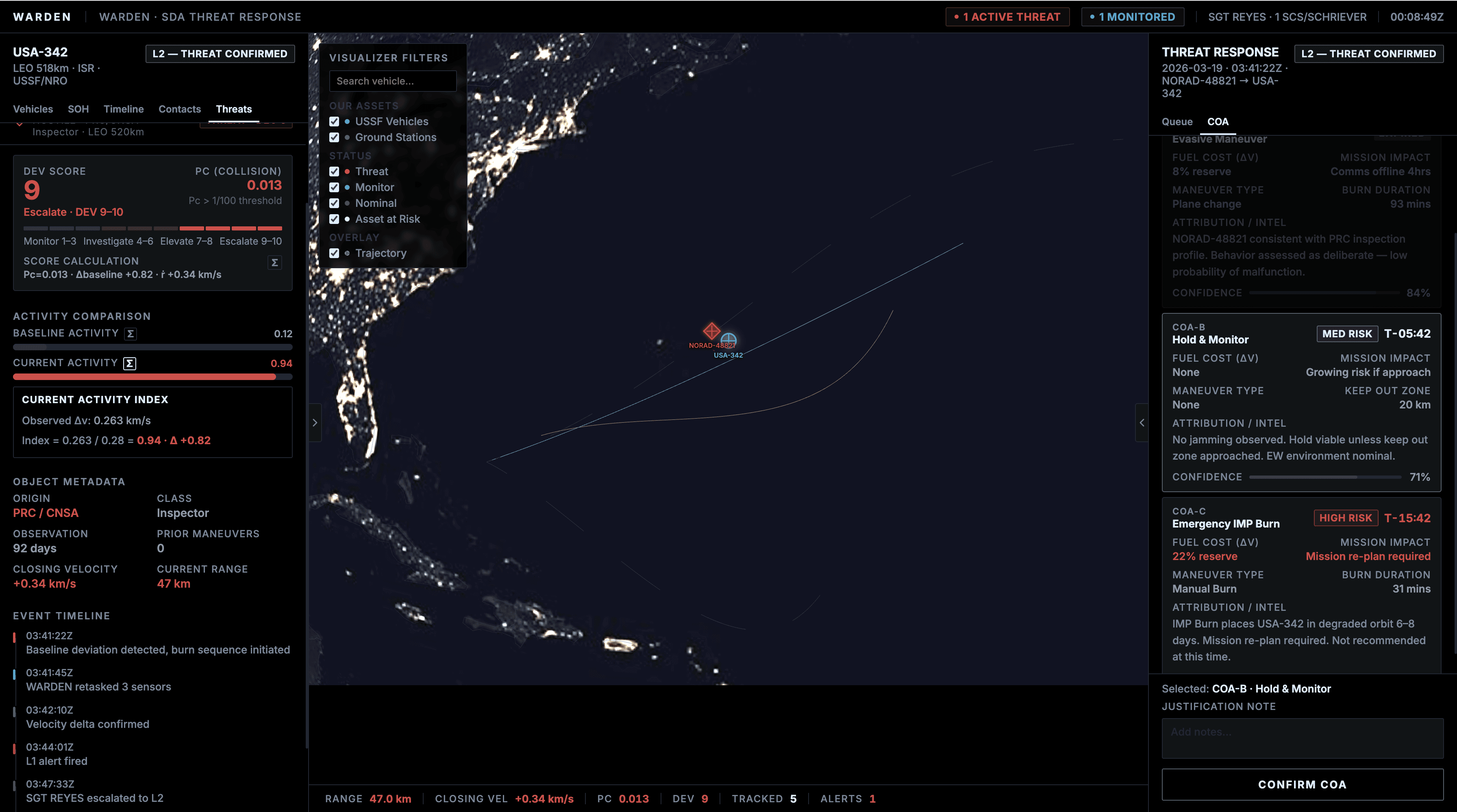
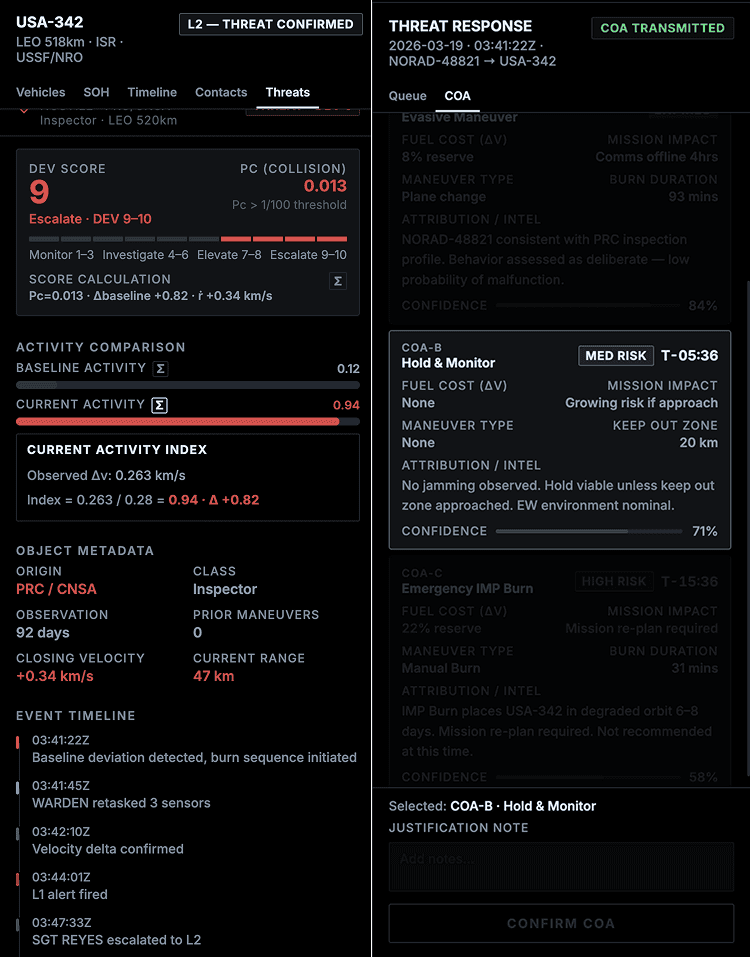
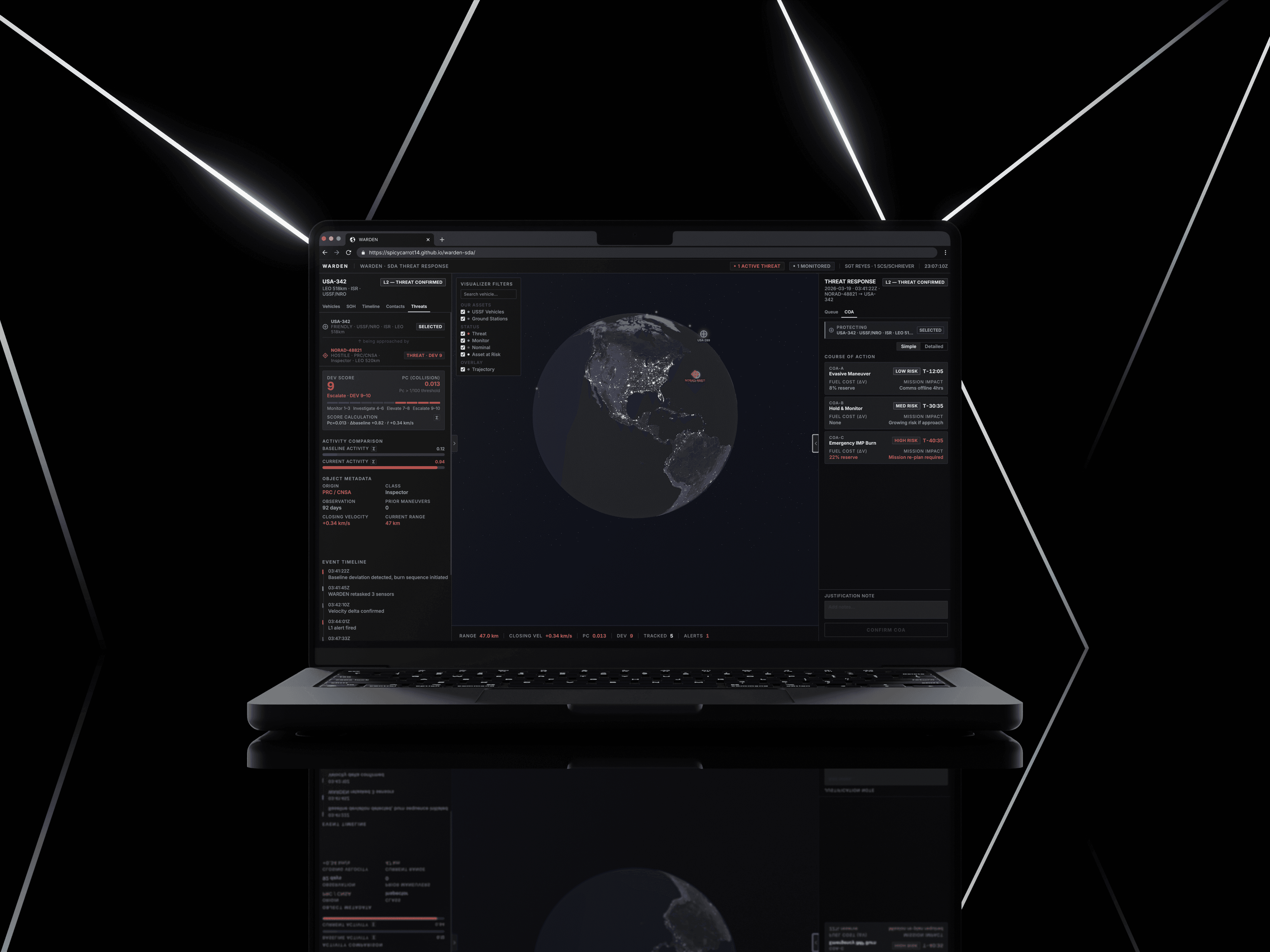
WARDEN is a fictional Space Force SDA platform designed to support defensive RPO threat response. The system covers the full escalation workflow from L0 baseline monitoring through L1 anomaly detection to L2 confirmed threat response, including trajectory prediction, deviation scoring, and COA selection with decision windows.
View full project here.
Company
Speculative / Portfolio
Timeframe
March 2026
Tools
Figma, HTML, CSS, JavaScript, Three.js, GLSL, Claude AI
Team
Emma Kalayjian (solo project)
Problem
Space Domain Awareness operators face a critical gap between anomaly detection and actionable threat response. Existing tooling fragments the workflow across multiple views, forces operators to reconstruct context under time pressure, and fails to communicate prediction confidence in a way that supports fast, defensible decisions. WARDEN asks: what would it look like if the entire escalation chain lived in a single, coherent interface?
Questions
How might we design a discrete, auditable state transition from anomaly detection to confirmed threat response?
How might trajectory prediction communicate confidence decay rather than false certainty?
How might COA options be surfaced with enough context for an operator to justify a decision up the chain?
How might an operator reconstruct full situational context mid-shift without starting from scratch?
How might a mission-critical interface meet accessibility standards without sacrificing operational density?
My Contributions
Defined mission hard requirements and product requirements across seven feature areas (PR-01 through PR-07)
Conducted user research framing through Space Force operator personas and Jobs to Be Done
Designed and built the full interactive prototype — HTML, CSS, JavaScript, and a custom Three.js Earth renderer with NASA Blue Marble and Black Marble textures
Implemented a GLSL day/night terminator shader with real-time J2000 solar ephemeris math
Designed MIL-STD-2525 compliant vehicle symbology and a full L0→L1→L2 escalation workflow
Applied WCAG 2.1 AA accessibility compliance throughout, including contrast ratios and minimum font sizing
Skillset
Product Strategy, UX Research, Interaction Design, Mission Workflow Design, Accessibility, Frontend Development, Data Visualization, Design + Dev
Process
Mission Objectives
Defined the operator context — a Space Force SDA operator making high-stakes decisions fast, with incomplete information, zero tolerance for alert fatigue, and a need to see exactly why something was flagged
Established mission hard requirements: discrete state transitions, confidence-communicating trajectory prediction, COA surfaces with decision windows, always-accessible escalation evidence
Product Requirements
Translated mission requirements into seven formal product requirements: L1→L2 state transition, single-view escalation surface, trajectory prediction with confidence decay, COA action component with decision windows, escalation evidence accessibility, deviation score transparency, logged decision package
Feature Engineering
Mapped the full defensive RPO workflow from L0 baseline through threat resolution and shift handoff
Identified five discrete feature areas: alert and notification, details panel with deviation tab, COA tab, visualizer filters, and trajectory/confidence overlays
Conducted a technical review to assess feasibility, flagging visualizer confidence level as requiring further scoping
Usability Review
Reviewed isolated features before integration — alert component, deviation panel, COA panel, escalation confirmation dialog
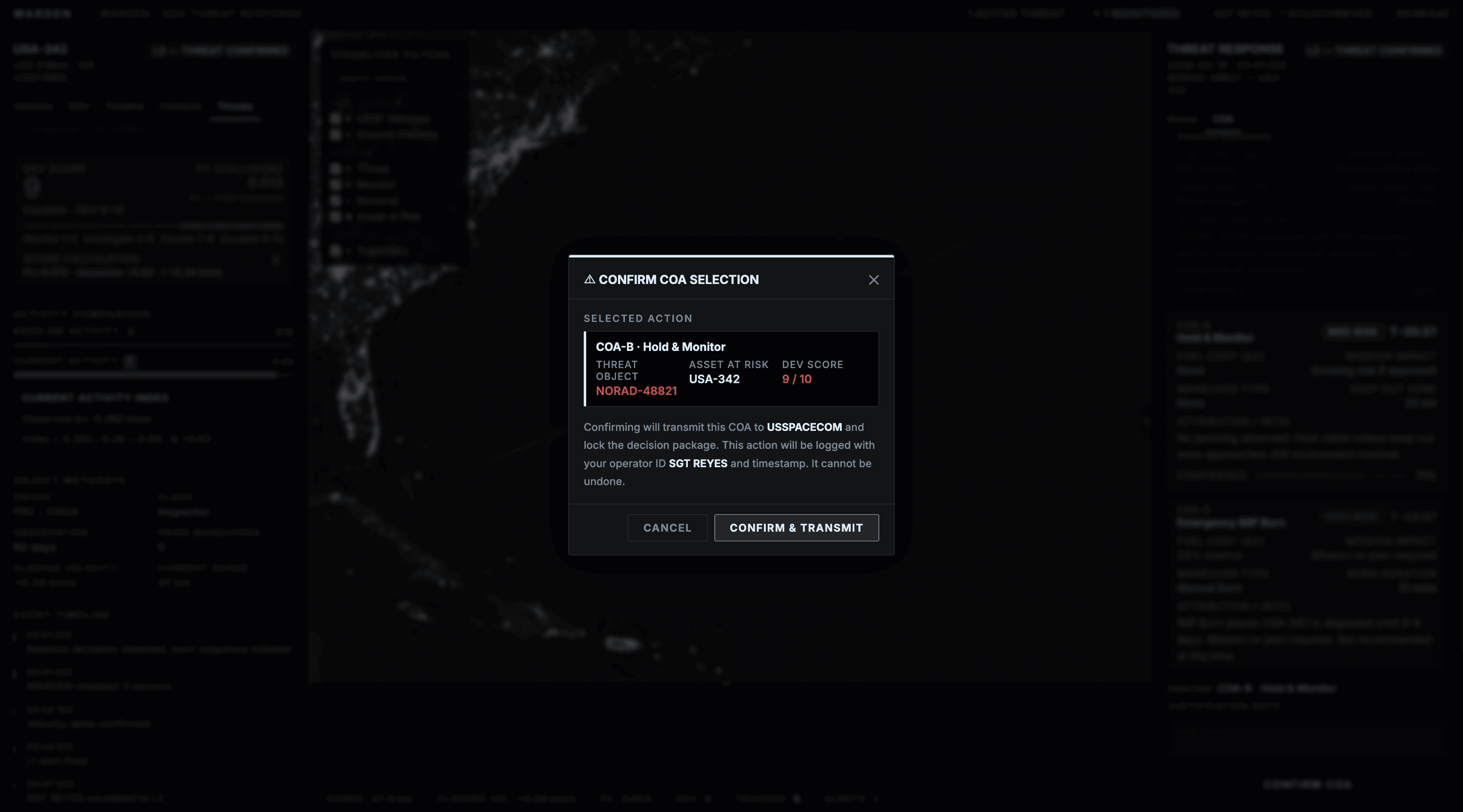
Discovered confirmation dialog requirement during review (user error prevention for an irreversible action)
Design + Dev
Built the full interface as a live deployed prototype using vanilla JS and Three.js
Replaced globe.gl with a custom Three.js Earth renderer featuring real NASA textures, a GLSL day/night terminator, animated MIL-STD vehicle markers, and COA trajectory overlays
Deployed to GitHub Pages at spicycarrot14.github.io/warden-sda
Highlights
Designed and built a full mission-critical SDA prototype end to end — research through deployed product
Implemented a custom Three.js globe with GLSL shaders and real NASA satellite imagery
Designed an L0→L2 escalation workflow grounded in real Space Force operational doctrine
Met WCAG 2.1 AA accessibility compliance throughout a dense, data-heavy operational interface
Conclusion
WARDEN demonstrates that high-stakes mission interfaces don't have to choose between operational density and usability. By grounding every design decision in mission requirements, operator context, and engineering reality — then building the prototype to production quality — the project shows the full range of what a senior product designer can bring to a complex defense software problem.
About
WARDEN is a fictional Space Force SDA platform designed to support defensive RPO threat response. The system covers the full escalation workflow from L0 baseline monitoring through L1 anomaly detection to L2 confirmed threat response, including trajectory prediction, deviation scoring, and COA selection with decision windows.
View full project here.
Company
Speculative / Portfolio
Timeframe
March 2026
Tools
Figma, HTML, CSS, JavaScript, Three.js, GLSL, Claude AI
Team
Emma Kalayjian (solo project)
Problem
Space Domain Awareness operators face a critical gap between anomaly detection and actionable threat response. Existing tooling fragments the workflow across multiple views, forces operators to reconstruct context under time pressure, and fails to communicate prediction confidence in a way that supports fast, defensible decisions. WARDEN asks: what would it look like if the entire escalation chain lived in a single, coherent interface?
Questions
How might we design a discrete, auditable state transition from anomaly detection to confirmed threat response?
How might trajectory prediction communicate confidence decay rather than false certainty?
How might COA options be surfaced with enough context for an operator to justify a decision up the chain?
How might an operator reconstruct full situational context mid-shift without starting from scratch?
How might a mission-critical interface meet accessibility standards without sacrificing operational density?
My Contributions
Defined mission hard requirements and product requirements across seven feature areas (PR-01 through PR-07)
Conducted user research framing through Space Force operator personas and Jobs to Be Done
Designed and built the full interactive prototype — HTML, CSS, JavaScript, and a custom Three.js Earth renderer with NASA Blue Marble and Black Marble textures
Implemented a GLSL day/night terminator shader with real-time J2000 solar ephemeris math
Designed MIL-STD-2525 compliant vehicle symbology and a full L0→L1→L2 escalation workflow
Applied WCAG 2.1 AA accessibility compliance throughout, including contrast ratios and minimum font sizing
Skillset
Product Strategy, UX Research, Interaction Design, Mission Workflow Design, Accessibility, Frontend Development, Data Visualization, Design + Dev
Process
Mission Objectives
Defined the operator context — a Space Force SDA operator making high-stakes decisions fast, with incomplete information, zero tolerance for alert fatigue, and a need to see exactly why something was flagged
Established mission hard requirements: discrete state transitions, confidence-communicating trajectory prediction, COA surfaces with decision windows, always-accessible escalation evidence
Product Requirements
Translated mission requirements into seven formal product requirements: L1→L2 state transition, single-view escalation surface, trajectory prediction with confidence decay, COA action component with decision windows, escalation evidence accessibility, deviation score transparency, logged decision package
Feature Engineering
Mapped the full defensive RPO workflow from L0 baseline through threat resolution and shift handoff
Identified five discrete feature areas: alert and notification, details panel with deviation tab, COA tab, visualizer filters, and trajectory/confidence overlays
Conducted a technical review to assess feasibility, flagging visualizer confidence level as requiring further scoping
Usability Review
Reviewed isolated features before integration — alert component, deviation panel, COA panel, escalation confirmation dialog
Discovered confirmation dialog requirement during review (user error prevention for an irreversible action)
Design + Dev
Built the full interface as a live deployed prototype using vanilla JS and Three.js
Replaced globe.gl with a custom Three.js Earth renderer featuring real NASA textures, a GLSL day/night terminator, animated MIL-STD vehicle markers, and COA trajectory overlays
Deployed to GitHub Pages at spicycarrot14.github.io/warden-sda
Highlights
Designed and built a full mission-critical SDA prototype end to end — research through deployed product
Implemented a custom Three.js globe with GLSL shaders and real NASA satellite imagery
Designed an L0→L2 escalation workflow grounded in real Space Force operational doctrine
Met WCAG 2.1 AA accessibility compliance throughout a dense, data-heavy operational interface
Conclusion
WARDEN demonstrates that high-stakes mission interfaces don't have to choose between operational density and usability. By grounding every design decision in mission requirements, operator context, and engineering reality — then building the prototype to production quality — the project shows the full range of what a senior product designer can bring to a complex defense software problem.
Gallery